The 360-Degree Customer Advocacy Model
- Silver Bishop Blog
- Sep 30, 2018
- 13 min read


Today’s businesses live and die through their approach to customer service. The mere mention of customer service can evoke overwhelmingly positive and negative experiences. Think about a truly exceptional experience that you’ve had with a business. Now think about the absolute worst. Which one was easier to recall? The negative experience was easier to recall and had more impact, right? Did that negative experience lead you to alter your relationship with the bad business – if not stop doing business with that company completely?
Let’s go beyond being treated badly. Think of any company you do business with from the perspective of being a customer. How do you feel about the company? Do you feel that they have your best interests in mind? Are you more than a number in their database? Do they respect your time by not leaving you on hold for excessive amounts of time, by finding answers quickly, and by offering alternatives to resolve your issue?
What about your personal and financial data? Do you feel like your data is safe with the company – or is it only a matter of time until a breach happens? After all – if you received poor service on the phone, who knows what else is happening behind the scenes?
In this article, I will explore a greater vision of what defines customer support. I will identify how creating a true relationship with your customers requires a vision, a mission, and a culture where customer advocacy and stewardship permeate throughout the business.
Redefining the Customer Experience
I dislike the phrase “customer service.” At it’s very best, “customer service” feels highly transactional. It rarely invests time or care. “Thank you for calling. Problem solved. Have a nice day.” Too many companies engage with customers on a transactional-only basis, never realizing the benefits of what building a relationship with customers really means. What do you envision when you think of “customer advocacy” and “customer stewardship”? These concepts feel bigger than customer service…because they are.
When we build a relationship (any relationship,) we invest time and effort into making it a positive experience. In a positive relationship we are willing to do more for the other person to protect and keep that relationship alive and well. This is the difference between transactional customer service and relational customer advocacy. True customer advocacy goes beyond the transaction to lift up the customer relationship as the driving influence of business. The business builds itself around Customer Advocacy internally and externally.
The Tripod of Care
Every relationship requires three core elements to thrive: Communication, Concern, and Trust. This is the Tripod of Care.
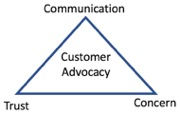
When we think of the Tripod of Care, we can relate these elements to every single real relationship that we conduct with every person in our lives. These elements are also alive and well in every single positive business transaction that we experience. This makes achieving the Tripod of Care more than mere guidelines. The Tripod of Care becomes a definition of success that supports the concepts of business vision, mission, business strategy, and culture. The Tripod of Care allows businesses to ask the right questions about how their business supports customers:
· How can we improve communication?
· How can we impart greater concern?
· How do we build a relationship of trust?
The Tripod of Care is the underlying framework for building a 360 Degree Customer Advocacy Model.

In this diagram, we see the 360 Degree Customer Advocacy model split into externally-facing and internally-facing operations. Externally-facing operations are what you want your customers to see. These operations define 50% of the customers perception of your brand. The other 50% resides in internal operations. Internal operations support the elements of a relationship that individuals may not be considering in every instance; tacit concepts and actions that build trust and strengthen the business-customer relationship. It is the role of businesses to consider these elements and understand how each impacts customer experience and perception – sometimes in profound ways.
The External Face of Customer Advocacy
Recall that this is what you want your customers to see in every interaction. External operations can be split between Softskills and Tools.
Softskills & Training – The Human Element
Softskills are loosely defined as, “personal attributes that enable someone to interact effectively and harmoniously with other people.” (Google, “Soft Skills”, 2018) Alison Doyle at thebalancecareers.com does a fine job of placing better definition on Soft Skills:
“Soft skills include attitude, communication, creative thinking, work ethic, teamwork, networking, decision making, positivity, time management, motivation, flexibility, problem-solving, critical thinking, and conflict resolution.” (thebalancecareers.com, September 2018)
I feel that it is also important for organizations to understand and train the concepts of Emotional Intelligence, Bias Recognition, and Diversity & Inclusion.
Many of these concepts are not intuitive. Worse yet, they are not topics taught by the US K-12 educational system. Many of these concepts can take years to master, yet one of the most common roles for those new to the professional world is that of Customer Service Representative. That’s where corporate training enters the picture.
Training is an investment in employees, security, and success because training supports the vision by offering a path that leads to success. Employees want to feel successful, too. By nature, humans want to belong to a pack – a team – and a successful team, at that. Employees want to know that their hard-work isn’t going into a proverbial black hole. Employees working in a positive employment paradigm both want and need training to grow their skills as a way to increase their value to the business.
Sadly, many companies have little training experience, resulting in poor training delivery, unfocused training, training on the wrong concepts, or no training at all.
“The problem is that many organizations see training as an expense and not as an investment. Untrained employees will, inevitably, lack the knowledge to use company resources properly, which will lead to waste, in a service industry; lack of knowledge about procedures will affect customer interaction and retention. Because of this, your employees, your company, and your clients will all suffer.” (shiftelearning.com, 2018)
Compensation
In the US, the median salary for a Customer Service Representative role is $34,573 per year, which equates to $16.62 per hour (salary.com) with women making up 65% of customer service roles (bostonglobe.com). Per paycheck, and after an estimated 28% in taxes removed, this leaves $957 every two weeks. The average rent in the US in 2017 was $864 per month (time.com, June 2017), with some market averages being double that amount.
How can a company expect happy customers with employees struggling to make enough money for the basics? Underpayment for a role – especially along the gender divide - is rampant throughout the US, and that can come back to haunt a company, as you’ll see in the next section.
Process & Policy – The Written Word
Organizational Processes & Policies fit under every category of the 360 Model, but they live under Culture. If we consider culture as a system of behaviors, then that system needs structure. Policies offer that structure by defining the cultural behaviors of the business. Processes support policy structure by defining how policy objectives are achieved. Together, processes and policies, when constructed and supported correctly, strengthen culture and success and enforce accountability. They are powerful guides when influencing how a customer support organization interacts with customers and safeguards information.
What happens when Process & Policy is not considered from every angle? Loosely defined policies do not protect a business or their customers. Quite the opposite. Even the largest, most well-known companies have experienced problems. Apple encountered this problem when Chinese employees were caught in a $7.4 Million ID theft scam in June of 2017. (digitalmusicnews.com, June 2018.) Amazon is currently investigating employees for selling proprietary customer data to sellers and accepting bribes to manipulate review data (theverge.com, September 2018.) I don’t believe that I need to mention Facebook after the negative press they received this year due to the Cambridge Analytica scandal. I can keep going – from instances of blatant disregard for law and property, to companies who didn’t train their employees about basic network security and were subsequently spearphished.
Data leakage from inside any organization is a very real threat. In 2015, computerweekly.com reported:
“According to a Clearswift poll of 4,000 employees in the UK, Germany, US and Australia showed that for £5,000, 25% said they would sell confidential company data, and risk both their job and criminal convictions.”
“The study, commissioned by security firm Clearswift, also revealed that 3% of employees would sell company information for as little as £100, while 18% would accept an offer of £1,000, and 35% were open to bribes of £50,000.”
These metrics should be a wake-up call for any organization that does not take customer data protection, corporate security policies, or compensation seriously. Developing tough policies around the protection of customer data and compensating the Customer Support team with a better wage isn’t just the right thing to do – it becomes an investment in customer data stewardship. If the business is Fort Knox, customer data is the gold which the business should seek to protect.
Management
Management is, sadly, another often misunderstood consideration. People leave bad organizations, sure – but they leave bad managers much more quickly. Excessive employee churn contributes to preventable onboarding costs.
“For your average small to medium business onboarding 100 new employees each year, onboarding can cost upwards of $40,000 per year. That's just onboarding, not including recruitment or training costs.” (hronboard.me, 2015)
While I can’t mention names, I’ve watched a business of ninety-plus employees nationally that has churned 33% of its workforce in the last eight months because of bad management and poor process documentation and adherence. In financial terms, that is $1.2 million wasted. They are now short-staffed. Customers feel it. Employees feel it. Morale across the company is crashing because of it, and their response to fix their poor morale is to become authoritarian. The vicious cycle will escalate – but it doesn’t have to be this way.
Many businesses hire people with management experience, but not in managing people. Other businesses promote technically adept workers with no people skills into managerial roles, which is also not a great way to lead. Good managers, on the other hand, can be stymied by a lack of upstream support and enablement. Senior managers or executives who disable good managers from finding working solutions to their employees’ problems is the equivalent of taking important tools away from a tradesman. With poor tools equal poor results.
Bad management, bad policies, and poor upstream support destroy morale. Anyone who has been on a team with bad morale knows how a bad attitude from even one disengaged employee can “infect” others, destroying productivity and the delivery of a positive customer experience. Bad morale is extremely difficult and expensive to repair.
“While more traditional managers tend to see low morale as intangible, its importance and impact on profits, productivity and financial competitiveness are measurable and affect organizational objectives. The Gallup Organization estimated that there are 22 million actively disengaged employees costing the economy as much as $350 billion dollars per year in lost productivity including absenteeism, illness and other low morale issues.” (barrettrose.com, 2018)
Managers must know how to effectively manage and motivate teams, recognize team and individual behaviors and needs, and recognize positive skill traits and potential in new hires – for the sake of the customer. Managers also need to understand how to effectively train and grow skills through positive motivational leadership and techniques. They must be enabled to compensate their team for using these skills expertly.
I don’t care if you’re in tech, retail, or the food service industry – leading and growing a positive-morale team that knows how to deftly wield soft skills, and meets expectations accountably leads to success and increased business. Just ask any of these companies.
Tools – Technical Operations
Nothing will destroy excellent service delivery, team morale, and corporate revenue faster than inefficient tools. Systems that don’t work properly. Lackluster CRM applications. Glitchy scheduling applications. Slow databases. Non-centralized communications. These are just a few of the many examples of applications that can contribute to success or failure in the customer engagement realm.
By not using the right tools for the job a business warmly welcomes waste and inefficiency, driving up business costs and suppressing revenue. The old saying that “time is money” applies here. A business unwilling to invest in the right people and the right tools to support the customer relationship fails to invest in the future success of the business.
Customer Service tools should satisfy customer support operations by providing:
• Ease of Communication
• Ease of Accuracy
• Ease of Efficiency
• Ease of Speed
• Ease of Use
• Enhanced Security
The Internal Face of Customer Advocacy
We have a good idea of what the external application of customer advocacy looks like. In a true customer advocacy organization though, we cannot stop there. The greatest investment in retaining and growing customers brings us to security. Security takes place through network infrastructure, corporate security posture, and the ability to protect customers through the prevention of breach events.
Network Security & Data Governance
Companies, especially small businesses, want IT and network support cheap. However, a lower price tag most commonly means reduced services and reduced quality of services – the same services that help to protect customer data and provide critical infrastructure to support the customer experience. A primary role of security is the responsible protection of business revenue. By proxy, shouldn’t the business also be responsible for safeguarding customer information? Yet we hear the same chorus over and over again about companies who didn’t take their cyber-security seriously resulting in breach events and theft of customer and business data, sometimes to the tune of millions of records.
“This year’s report found that the average total cost of a breach ranges from $2.2 million for incidents with fewer than 10,000 compromised records to $6.9 million for incidents with more than 50,000 compromised records.” (securityintelligence.com, Jan 2018)
If your business fell victim to a data breach, how would you respond? Based on the numbers presented, could your business afford a breach? How would your customers respond? Will they have the same faith in your ability to safeguard their information after a data breach? These are not passive questions. These are real, present-day business risks.
“You’re more likely to experience a data breach of at least 10,000 records (27.9 percent) than you are to catch the flu this winter (5–20 percent, according to WebMD).” (securityintelligence.com, Jan 2018)
Compliance
Compliance is another topic that will be heard more in the next few years now that the EU has placed GDPR in effect. Any company found in violation of GDPR rules are likely to face stiff penalties.
“The data breach penalties that will shortly come into place are either a fine of up to €10m or 2% of turnover, or up to €20m or 4% of annual turnover.” (gdpr.associates, 2018)
These are considerable fines, but so far are contained to companies who have European customers – even in the US. US states are also crafting compliance regulations to stem the tsunami of data breach events affecting US consumers. From a strategic perspective it is far better to enact a system of best practices early, even adopting some (if not all) compliance regulations as a general security posture. Data governance and protection for all.
Disaster Recovery
Another common network neglect is disaster recovery (DR). Disasters (both man-made and nature-made) happen. Hurricanes that flood businesses. Tornados that flatten data centers. Ransomware. DDoS attacks. Critical hardware failures. All of these can be contributing causes of unexpected downtime. Businesses and customers alike feel the impact of disasters through critical service disruptions. Businesses who have no DR posture feel the impact most by way of lost revenue.
“In the Disaster Recovery Preparedness Benchmark Survey, the cost of outages added up to more than $50,000 in losses, on average, with bigger companies citing losses up to $5 million.” (echopath.com, 2018)
Can your business afford (literally) to go one hour, or one day, or even one week without having vital business services running in a separate center? More importantly – can your customers afford it? Disaster Recovery is a priority of most Business Continuity plans. DR is a cost of doing business. DR is like a network insurance policy. You hope you don’t need it, but you’re glad to have it when it pays off.
Culture and Attitude
Culture is a hot buzzword right now. We need to elevate it in this conversation, because I see a lot of companies talk a good game about culture, but their actual delivery is BS.
“Corporate culture refers to the beliefs and behaviors that determine how a company's employees and management interact and handle outside business transactions. Often, corporate culture is implied, not expressly defined, and develops organically over time from the cumulative traits of the people the company hires.” (Investopedia, 2018)
I have beef with the definition above. Culture should be expressly defined. The attitudes that support the vision and mission of customer advocacy should be explicit and clear. A business cannot expect to live up to an undefined cultural ideal. It’s the same as wanting to travel to a specific place with no map and no plan on how, or what you’ll need, to get there.
I do agree that culture develops over time, but that development should be an explicit refinement of the culture – not a destruction of it, nor a deviation from it unless that deviation enables increased customer advocacy. If the business has employees working against the vision, mission, or values, then the business has either hired poor fits, or is not pulling its weight in broadcasting its message to employees – and that comes straight from the top of the business.
Customer advocacy cannot happen without executives who understand its importance and champion the cause. This attitude of helping and protecting customers should be the very heart and soul of the business. Customer Advocacy ignites the business vision, mission, culture, and is the responsibility of every single employee - no matter the role.
Just in case you’re not influenced by the impact of being a good customer advocate, there are metrics to speak to that, too…
76 percent of (consumers) would take their business elsewhere due to negligent data handling practices. Additionally, 75 percent of consumers stated they were likely to stop purchasing from a company if a data breach was found to be linked to the board failing to prioritize cyber security. (helpnetsecurity.com, May 2016)
U.S. companies lose more than $75 billion annually due to poor customer service. (Forbes.com, 2018)
More than half of Americans have scrapped a planned purchase or transaction because of bad service. (Helpscout.net, 2018)
33% of Americans say they’ll consider switching companies after just a single instance of poor service. (Helpscout.net, 2018)
Americans tell an average of 15 people about a poor service experience, versus the 11 people they’ll tell about a good experience. (Helpscout.net, 2018)
74% of people are likely to switch brands if they find the purchasing process too difficult. (Helpscout.net, 2018)
After one negative experience, 51% of customers will never do business with that company again. (Helpscout.net, 2018)
It is anywhere from 5 to 25 times more expensive to acquire a new customer than it is to keep a current one. (Helpscout.net, 2018)
The Close
None of this article is meant to scare or be sensational. It’s meant to make readers think about how deeply an attitude of Customer Advocacy can run in a business. Concern for customers shouldn’t stop at the end of a phone call, or an e-mail, or a live chat, because those interactions are just the beginning of what it takes to build a dynamic customer relationship.
Having a pervasive culture of customer advocacy (not just customer service) is the most important attitude that a business can express in the 21st century economy. A business cannot expect to achieve success unless making the customer experience an exceptional priority goes beyond live transactions. Creating that sense of Advocate Priority requires investments in time, money, manpower, and infrastructure. These investments pay for themselves as the business reaps the rewards of positive experience after positive experience translating into rewards of increased sales volume and increased revenue.
Comments